From Salon Chair to Bathroom Mirror: Closing the Blowout Gap with the Right Tools and Honest Conversations
There is a particular kind of frustration that salon professionals know well: the client who returns two weeks after a flawless blowout, visibly deflated, insisting that whatever was done in the chair simply "doesn't work" at home. She followed every step she could remember. She bought a new brush. She even watched a tutorial. And still, the result bore almost no resemblance to what left your chair.
This is not a failure of effort. It is almost always a failure of equipment, formulation, and informed technique—three variables that stylists control completely in the salon and clients navigate largely in the dark at home. Bridging that gap is one of the most practical services a professional can offer, and it begins long before the client reaches her own bathroom.
Why the Salon Environment Is Inherently Advantaged
Before addressing solutions, it is worth being precise about the problem. A professional blowout succeeds for reasons that extend well beyond skill alone. Salon-grade dryers typically operate between 1,800 and 2,000 watts, delivering consistent airflow that most consumer models simply cannot replicate. The ionic technology in professional units breaks down water molecules more efficiently, reducing drying time and minimizing the heat exposure that causes frizz and damage.
Beyond wattage, the nozzle attachments matter enormously. A concentrator nozzle directs airflow in a controlled stream, allowing the stylist to tension the hair precisely while sealing the cuticle in a downward direction. Without this focused airflow, clients using wide-diffuser or nozzle-free dryers scatter heat unpredictably, often lifting the cuticle rather than smoothing it.
Then there is the sectioning. Professional stylists work in deliberate, methodical sections—typically starting at the nape and building upward—ensuring that each portion of hair receives full, even attention. Most clients, pressed for time, work in loose, overlapping sections that leave some areas underdried and others overworked.
The Product Formulation Divide
Perhaps the most significant and least discussed contributor to the salon-to-home gap is the difference between professional and consumer product formulations. Retail products sold in drugstores and mass-market beauty retailers are frequently diluted compared to their professional-grade counterparts. This is not mere brand perception—it reflects genuine differences in active ingredient concentration, film-forming agents, and heat-protective compounds.
A professional blowout spray used in the salon may contain higher concentrations of polymers that create slip and control without weighing the hair down. Consumer versions of similar products often rely on heavier conditioning agents that perform adequately on damp hair but can become sticky or stiff under sustained heat.
This is where stylists hold an extraordinary advantage: they can recommend professional-line retail products that more closely mirror what is used in the chair. Many professional brands—including lines available through licensed distributor channels—offer retail versions specifically formulated for at-home use while retaining a higher degree of efficacy than mass-market alternatives. Educating clients about this distinction, and stocking those options at the front desk, is one of the most direct ways to extend the salon experience beyond the appointment.
The Brush Conversation Clients Need to Have
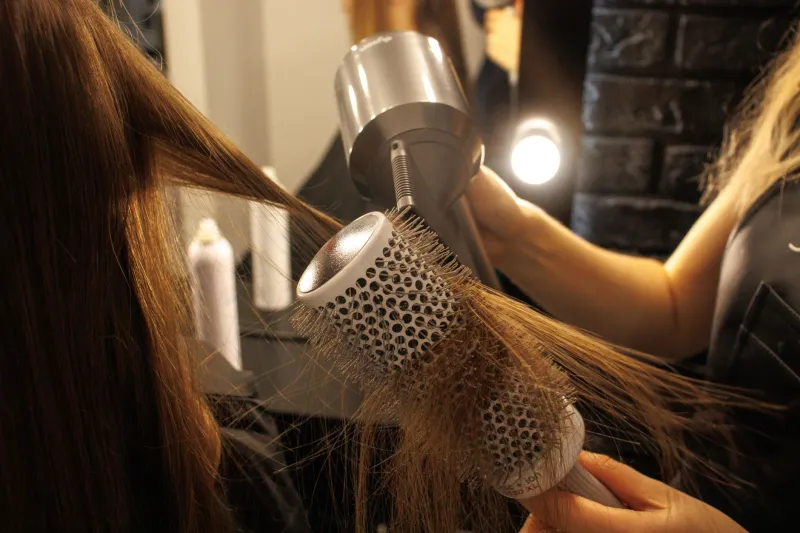
Ask a client what brush she uses at home, and the answer will reveal much about why her results fall short. The round brush is both the most essential and the most misunderstood tool in blowout styling. Barrel diameter, bristle type, and core material all influence outcome significantly.
For fine to medium hair, a smaller-diameter boar bristle brush creates tension and polish without over-stretching the strand. For thick or coarse hair, a larger barrel with a combination of nylon and boar bristles provides the grip needed to smooth and direct volume. Many clients own a single brush purchased more or less at random and use it regardless of the result it produces.
Stylists should take a moment during or after the service to show clients which brush was used and explain why. A brief, specific recommendation—"For your hair type, you want a one-and-a-quarter-inch boar bristle brush, not the paddle you've been using"—is the kind of precise, professional guidance that clients genuinely cannot find anywhere else. It also reinforces the value of the stylist relationship in a way that no product advertisement can replicate.
Technique Adjustments That Make a Measurable Difference
Beyond tools and products, there are several technique refinements that stylists can communicate clearly to clients during the appointment itself.
Tension is everything. The reason a professional blowout looks so smooth is not heat alone—it is the combination of heat and consistent mechanical tension applied simultaneously. Encourage clients to hold the brush firmly and keep the hair taut as they pass the dryer over each section. Loose, casual brushing while drying produces loose, casual results.
Cool-shot finishing is non-negotiable. The cool-shot button on a dryer exists for a reason that most clients either ignore or forget. After each section is dried and shaped, a brief blast of cool air sets the cuticle in place, locking in the shape and dramatically extending how long the style holds. This single step, consistently skipped at home, accounts for a significant portion of the longevity difference between salon and home results.
Drying to completion matters. Clients frequently stop blow-drying while hair is still slightly damp, particularly in sections closer to the roots that feel dry to the touch but retain moisture at the scalp. Hair that is not fully dried before styling loses its shape faster and is more vulnerable to humidity. Stylists should advise clients to err on the side of thoroughness rather than speed.
Setting Realistic Expectations Without Diminishing the Service
One of the more delicate aspects of this conversation is managing expectations without inadvertently suggesting that the salon visit is unnecessary. The goal is not to make the at-home blowout identical to the professional result—that standard is unrealistic and ultimately unfair to clients who do not have years of training.
The goal is to make the at-home result genuinely good: polished, smooth, and lasting. When clients achieve a result they are proud of, they return to the salon more confidently and with greater appreciation for the elevated outcome a professional delivers. The comparison becomes a point of pride rather than a source of frustration.
Framing the conversation this way—positioning the stylist as a coach rather than a gatekeeper—strengthens the client relationship and positions the salon as a resource for ongoing education, not just periodic appointments.
A Practical Checklist to Send Home
Consider providing clients with a brief, branded take-home guide that outlines the essentials: the recommended brush type, the product or two that will best replicate the salon finish, the importance of sectioning and cool-shot finishing, and a note on drying time. This does not require elaborate printing—a simple card or a follow-up text with bullet points accomplishes the same goal.
Clients who feel equipped perform better at home. Clients who perform better at home come back more often, refer others more readily, and trust their stylist's expertise more deeply. The blowout gap, in other words, is not just a styling problem. It is a client retention opportunity waiting to be claimed.