No Two Strands Are the Same: Why Adaptive Styling Techniques Outperform Generic Methods Every Time
The Comfortable Habit That's Quietly Undermining Results
Every stylist develops a rhythm. After years behind the chair, certain techniques become second nature—a default blow-dry sequence, a go-to diffusing method, a familiar curl-enhancing routine. This muscle memory is, in many ways, a sign of professional maturity. But it carries a hidden risk that even experienced practitioners can overlook: when a reliable method becomes a universal method, the individuality of each client's hair quietly gets erased.
The consequences rarely announce themselves dramatically. Instead, they surface in subtle ways—a client whose waves fall flat by noon, another whose color-treated ends snap under the tension of a round brush, a third whose tight coils lose definition rather than gain it. These outcomes are not failures of effort. They are, almost always, failures of fit. The technique was sound. The hair simply required something different.
Understanding why this happens—and how to course-correct—is one of the most valuable shifts a salon professional can make.
What Generic Styling Actually Ignores
To appreciate why personalization matters so profoundly, it helps to consider what generic approaches tend to overlook. Hair is not a uniform material. Even among clients with ostensibly similar textures, significant variation exists across three critical dimensions: porosity, structural integrity, and moisture-protein balance.
Porosity determines how readily the hair shaft absorbs and retains moisture. High-porosity hair—common in chemically processed, heat-damaged, or naturally coarse strands—drinks in product aggressively but releases it just as fast. Low-porosity hair, often found in finer or naturally dense textures, resists moisture absorption entirely, leaving products sitting on the surface rather than penetrating the cortex. A hydrating serum that transforms one client's blowout can leave another's hair greasy and limp within hours—not because the product is inferior, but because it was prescribed without a porosity assessment.
Structural integrity refers to the actual condition of the cuticle and cortex. Hair that has sustained damage through repeated chemical services, excessive heat, or environmental stress behaves fundamentally differently under tension, humidity, and thermal tools than hair in its natural, uncompromised state. Applying the same blow-dry temperature and brush tension to fragile, over-processed ends as to healthy, virgin hair accelerates breakage in ways that may not be immediately visible—but will absolutely be felt over time.
Moisture-protein balance is perhaps the most nuanced variable of all. Hair that is protein-deficient feels mushy, stretches excessively before snapping, and lacks resilience. Hair that is protein-overloaded feels brittle, stiff, and prone to breakage with minimal manipulation. A styling regimen that doesn't account for this balance will either exacerbate an existing imbalance or fail to address the root cause of a client's persistent styling frustrations.
Diagnostic Questions That Belong in Every Consultation
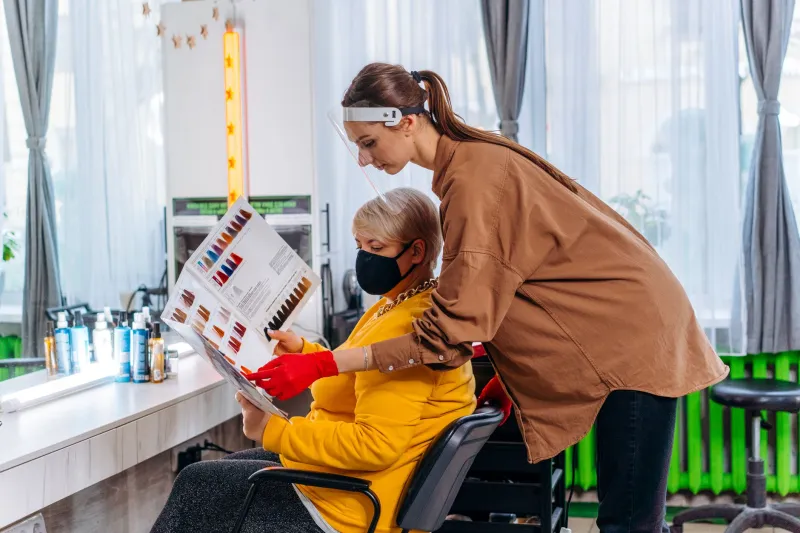
The solution to formulaic styling is not complexity—it is intentional inquiry. Before a single product is applied or a tool is switched on, the following questions should shape the professional's approach:
- How does your hair respond after washing? Does it feel rough and tangled (a sign of high porosity) or smooth but slow to dry (low porosity)?
- How long does moisture seem to last after conditioning? Rapid moisture loss suggests the cuticle is not sealing effectively.
- Have you noticed increased shedding, snapping near the ends, or a loss of your natural curl pattern? These are hallmarks of structural compromise.
- What heat tools do you use at home, and how frequently? Regular flat iron use at high temperatures without heat protection compounds damage in ways that alter how hair responds to professional styling.
- Has your hair changed in the past six to twelve months? Hormonal shifts, dietary changes, stress, and medication can all alter hair's porosity and density—sometimes dramatically.
These questions are not time-consuming. They are investment-generating. A three-minute diagnostic conversation can prevent a thirty-minute corrective service down the line.
Adaptive Styling in Practice: Three Salon Scenarios
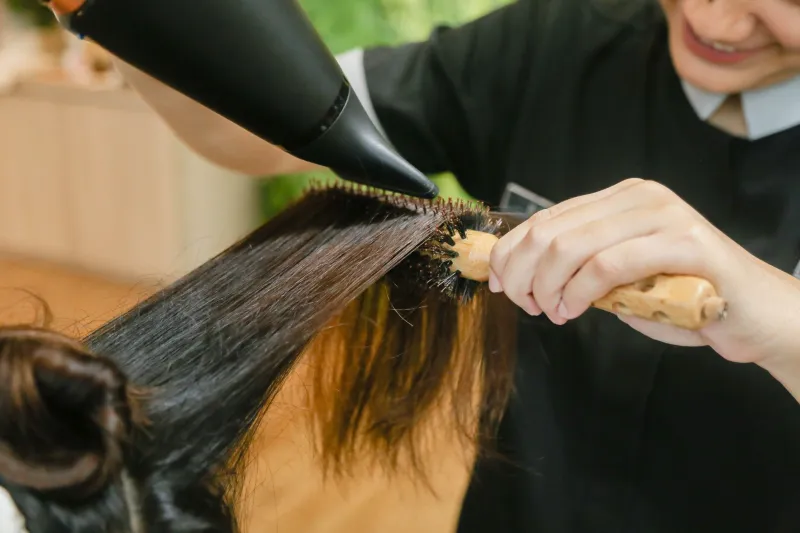
Scenario One: The Client with Fine, Color-Treated Hair A client arrives with shoulder-length hair that has been highlighted every eight weeks for the past two years. She wants volume and smoothness. A standard blowout with a large round brush and high heat might seem appropriate—but closer inspection reveals significant porosity elevation at the mid-lengths and ends. The correct adaptive approach involves reducing heat to a medium setting, using a lightweight protein-infused thermal protectant before drying, and switching to a paddle brush for the ends to minimize tension. The result is smoother, fuller hair without the brittleness that would have developed under a conventional routine.
Scenario Two: The Client with Type 4 Coils Seeking Elongation A client with densely coiled hair wants her natural texture stretched and defined without the use of chemical relaxers. A one-size diffusing method applied without prior assessment risks disrupting her curl pattern entirely. The adaptive approach begins with a leave-in conditioner layered beneath a medium-hold cream—not a gel, which would create excessive rigidity in tighter coil patterns—followed by a low-heat diffusing session that prioritizes root lift before addressing mid-shaft definition. This sequence honors the hair's natural architecture rather than working against it.
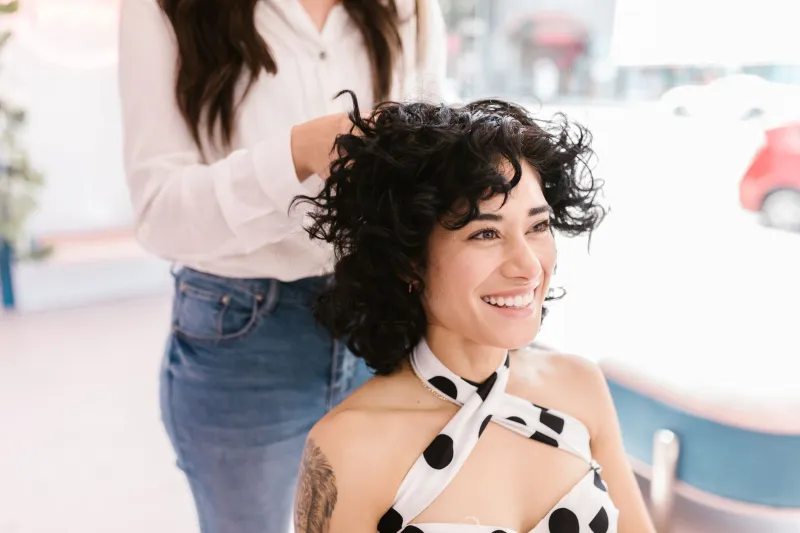
Scenario Three: The Client with Wavy Hair and Low Porosity A client with 2B waves complains that her hair never holds a curl past mid-morning. She has tried multiple curl creams with no success. The issue is not product quality—it is porosity. Low-porosity hair requires warmth to open the cuticle before products can penetrate. The adaptive solution involves applying a lightweight curl activator to damp hair while using a diffuser on low heat from the outset, allowing the warmth to assist absorption before the style sets. The result is definition that holds throughout the day.
Building a Personalized Styling Framework
Adaptive styling is not about reinventing the wheel for every single client. It is about developing a diagnostic framework that allows the stylist to quickly and accurately categorize the hair's current state—and then select from a repertoire of proven techniques accordingly.
Salon professionals who embrace this approach find that their results become more consistent, their client retention improves, and their reputation for expertise deepens. Clients do not simply want their hair to look good in the salon chair. They want techniques and guidance that translate into results they can reproduce—or at least maintain—between appointments.
That reproducibility begins with understanding. And understanding begins with treating every head of hair as its own distinct subject of study.
The Standard That Sets Professionals Apart
In an industry where trends move quickly and social media creates the impression that a single viral technique can work for everyone, the professionals who endure are those who resist that oversimplification. They ask better questions. They observe more carefully. They adjust without hesitation when the hair signals that a different approach is needed.
Generic styling techniques are not inherently wrong. They become problematic only when applied without discernment. The stylist who understands when to follow a standard method—and when to depart from it—is not working harder. They are working with far greater precision.
At Hair Bar Professional, that precision is the standard. Every strand deserves a technique built around what it actually is, not a generalized assumption of what hair is supposed to be.