Beyond Talent: Why the Tools in Your Kit Define the Work on Your Chair
There is a persistent myth in the beauty industry—one that circulates in break rooms, floats through social media comment sections, and occasionally surfaces in cosmetology school pep talks. The myth goes something like this: a truly skilled stylist can produce exceptional results with any tool. Talent, the thinking goes, is the variable that matters most.
The professionals who have spent years behind the chair will tell you a different story.
The Equipment Reality Behind the Finished Look
When a client leaves the salon with a blowout that defies humidity for three days, or a color so dimensional it photographs like a magazine spread, the instinct is to credit the stylist's expertise. That credit is not entirely misplaced—but it is incomplete. Behind every consistently exceptional result is a supply chain of professional-grade equipment that makes precision possible in the first place.
Consider the blow dryer. Consumer models typically operate between 1,200 and 1,600 watts. Professional-grade dryers, by contrast, range from 1,800 to 2,400 watts and incorporate ionic and ceramic technologies designed to close the hair cuticle, reduce frizz, and dramatically cut drying time. Less time under heat means less cumulative thermal exposure—and that matters enormously for the long-term integrity of the hair.
"I switched to a professional ionic dryer three years into my career, and within a month my clients were noticing that their blowouts felt softer and lasted longer," says Renata Solano, a senior stylist based in Austin, Texas. "I hadn't changed my technique. The tool did the work."
Shears: The Most Underestimated Investment in the Kit
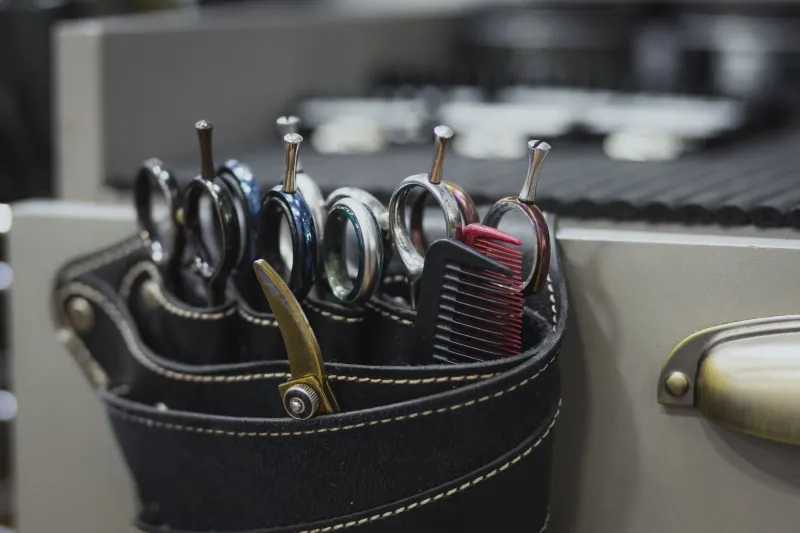
If the blow dryer is the workhorse of the styling toolkit, shears are its precision instrument—and few equipment decisions carry more consequence. Dull or poorly balanced shears do not simply make cutting more difficult. They actively damage the hair shaft with each stroke, creating microscopic compression at the cut point that leads to split ends, fraying, and a loss of the clean lines that define a professional finish.
High-quality Japanese or German steel shears, properly maintained and regularly sharpened, glide through the hair rather than folding it. The difference is immediately visible in the finished cut and palpable in the stylist's hand—a critical point that often goes undiscussed.
Repetitive strain injuries, including carpal tunnel syndrome and tendinitis, are among the most common occupational hazards in the salon industry. Ergonomically designed, properly weighted shears reduce the muscular effort required with each cut. Over the course of a ten-appointment day, across a thirty-year career, that reduction in strain is the difference between longevity and early retirement.
"I started noticing aching in my right hand after long days in my second year," recalls Marcus Thibodeaux, a master barber and educator in New Orleans. "My mentor convinced me to invest in a quality offset shear with a swivel thumb ring. Within weeks the discomfort was gone. I've been practicing for nineteen years. I credit that decision with keeping me in this industry."
Flat Irons, Curling Wands, and the Thermal Precision Problem
The styling iron market is saturated with options at every price point, and the variation in quality is more dramatic than most clients—or even some stylists—realize. The core issue is thermal consistency. Budget irons fluctuate significantly from their stated temperature, creating unpredictable hot spots that scorch fine hair or fail to smooth coarser textures effectively.
Professional-grade flat irons and curling wands use advanced sensor technology to maintain stable, accurate temperatures throughout the service. For stylists working with chemically treated or color-processed hair, that consistency is not a luxury—it is a safeguard. The margin between the temperature that smooths a keratin-treated strand and the temperature that damages it is narrower than most consumers appreciate.
The plate material matters as well. Titanium heats quickly and maintains temperature under pressure, making it ideal for thick, coarse hair. Ceramic distributes heat more evenly and is better suited to fine or fragile strands. Tourmaline-coated plates emit negative ions that combat frizz without requiring excessive passes. Understanding these distinctions—and owning tools that match the clientele being served—is part of what separates a professional practice from a generalist one.
Brushes, Combs, and the Overlooked Foundations
No conversation about professional tools is complete without addressing the brushes and combs that form the foundation of nearly every service. Boar bristle brushes, natural rubber cushion bases, and seamless wide-tooth combs are not simply premium alternatives to drugstore options—they are functionally different instruments.
Seamless combs, for instance, eliminate the micro-ridges left by the molding process in cheaper alternatives. Those ridges catch and snag the hair cuticle during detangling and sectioning, causing breakage that a client may not notice immediately but will certainly see in the weeks that follow. Boar bristle brushes distribute the scalp's natural oils along the hair shaft, adding shine and reducing static in ways that synthetic bristles cannot replicate.
"My kit is the most expensive thing I own," says Priya Chandrasekaran, a colorist and stylist in Chicago with a twelve-year practice. "But I think of it as capital equipment, not a purchase. It generates my income every single day. Cutting corners there is cutting corners on my business."
Calculating the True Cost of Under-Investment
The upfront cost of professional-grade tools is a genuine barrier for new stylists, particularly those emerging from cosmetology programs burdened with student debt. The calculus, however, rewards closer examination.
A quality pair of shears priced at $300 to $500, properly maintained, will outlast five pairs of $60 alternatives—and will produce better results throughout their lifespan. A professional dryer priced at $200 to $400 reduces service time, which translates directly to more appointments per day and lower heat damage complaints. The return on these investments is not abstract; it is measurable in client retention rates, referral volume, and the absence of costly corrective services.
The salon industry in the United States is highly competitive. Clients have more options than ever and are increasingly sophisticated about the results they expect. In that environment, equipment quality is not merely an operational detail—it is a component of the professional brand that every stylist builds, appointment by appointment.
Building a Kit That Grows With Your Career
For stylists at every stage, the most practical approach is strategic, phased investment. Prioritize the tools that touch the hair most frequently and carry the greatest risk of damage when they underperform—shears and thermal tools first, followed by dryers and brushes. Research brands with strong professional reputations, seek guidance from experienced mentors, and attend industry trade shows such as America's Beauty Show or Premiere Orlando, where hands-on comparisons are possible before purchase.
Maintenance is equally essential. Shears should be professionally sharpened every three to six months depending on usage. Dryer filters should be cleaned weekly. Plates and barrels should be wiped down after every service to prevent product buildup that compromises thermal performance.
Talent, without question, is what brings clients back. But talent expressed through inferior tools is talent constrained. The stylists who build lasting, distinguished careers are those who understand that excellence is a system—and that the tools in their kit are as much a part of that system as the hands that hold them.